Robotic vs. Manual Welding
A practical decision guide for manufacturers — production volume, repeatability, flexibility, and long-term cost, from a shop that runs both processes in-house.
Neither process is better. One of them is better for your part.
Robotic and manual welding are not competing technologies — they answer different questions. Robotic welding answers "how do we weld this same part, the same way, over and over?" Manual welding answers "how do we weld this part right now, when every one is different?" The right choice comes down to a handful of decision factors.
Choose robotic when the part repeats
- Recurring production runs with stable, released designs
- Parts that fit the robot cell's working envelope and torch access
- Batches where weld-to-weld repeatability matters
- Programs where fixturing and programming can be amortized across the run
Choose manual when every part is different
- One-offs, first articles, prototypes, and short runs
- Weldments too large or awkward for a robotic cell
- Designs that are still changing between builds
- Fit-up, tacking, rework, and repair
The decision factors that matter
| Factor | Robotic Welding | Manual Welding |
|---|---|---|
| Best suited for | Recurring production runs of the same part or family of parts | One-offs, prototypes, short runs, and repair work |
| Production volume | Pays off as quantities grow and the same joints repeat | Practical at any quantity, including a single piece |
| Repeatability | The robot runs the same programmed path, travel speed, and weld parameters on every cycle | Depends on the individual welder; varies with fatigue and part access |
| Upfront investment | Programming plus dedicated weld tooling and fixtures for the part | Minimal — a skilled welder, a power source, and basic fixturing |
| Cost per part over time | Setup cost is spread across the run; per-part cost drops as volume rises | Per-part cost tracks labour hours and stays roughly flat |
| Changeover & flexibility | New or revised parts need reprogramming and often new fixturing | Switch parts or designs with no programming lead time |
| Part size & access | Parts must fit the cell envelope and present joints the torch can reach | Handles large, awkward, or hard-to-reach weldments |
| Fit-up tolerance | Needs consistent, well-fixtured fit-up to weld repeatably | A welder can adapt in real time to gaps and variation |
What robotic welding actually buys you
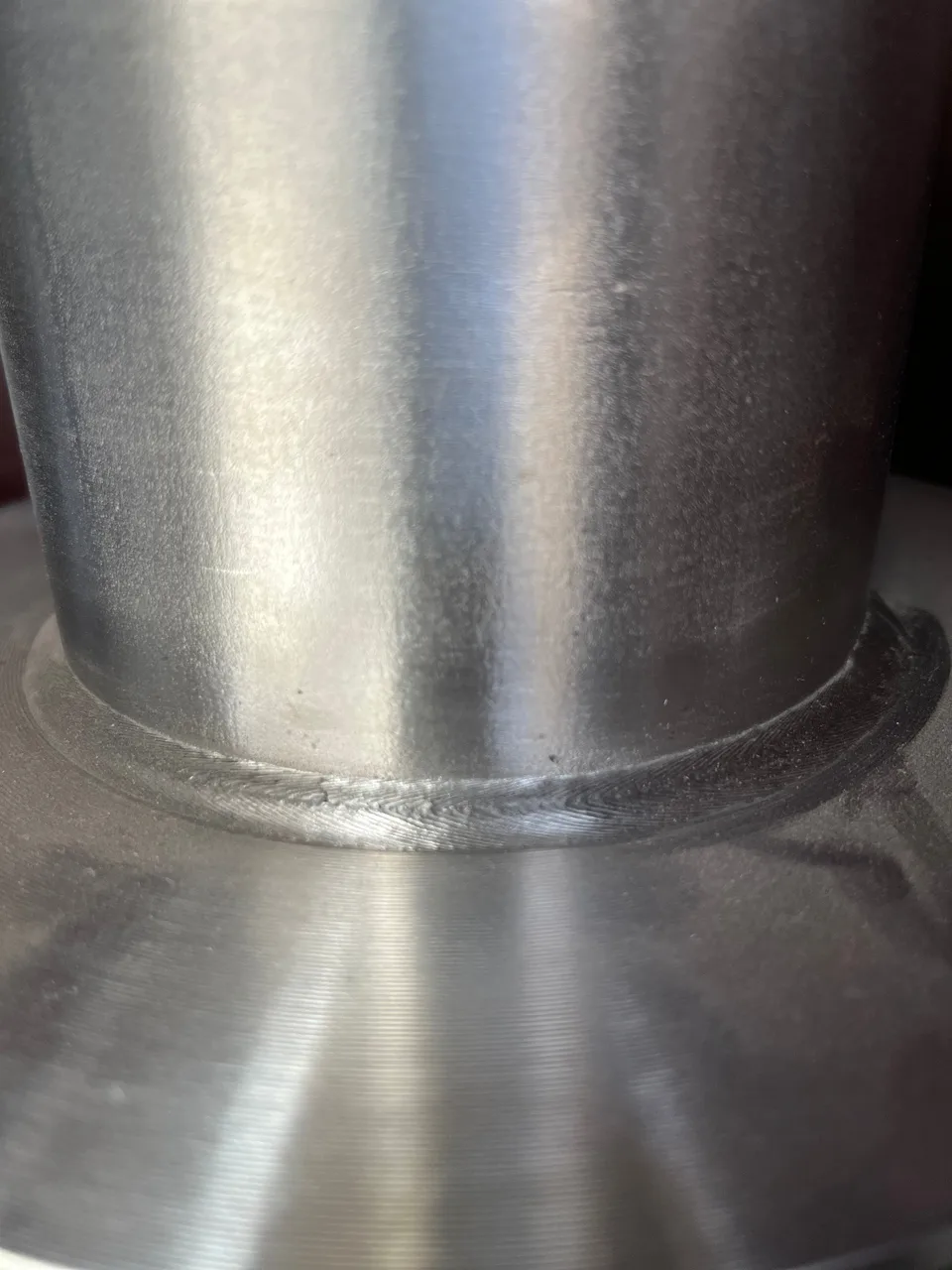
A welding robot's real product is not speed — it is repeatability. Once a part is programmed and fixtured, the robot runs the same torch path, travel speed, and weld parameters on every cycle, whether it is the first part of the shift or the last. That removes the variation that comes with manual work across long runs: heat input stays consistent, weld size stays consistent, and downstream operations see the same part every time.
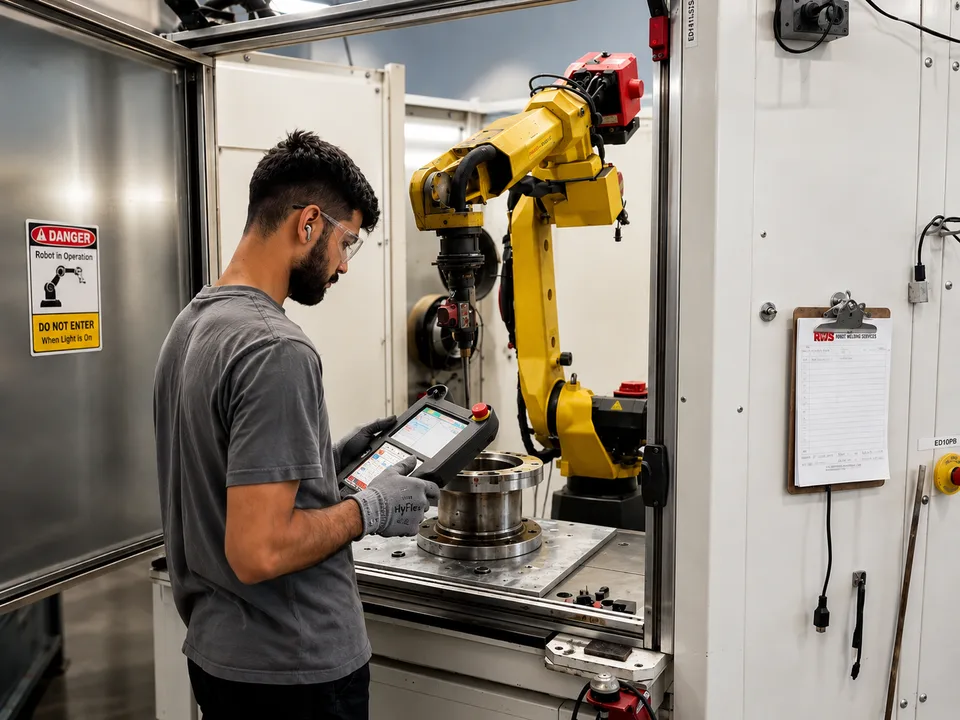
The trade-off is rigidity. The robot only repeats what it has been taught, so it needs a stable design, consistent fit-up, and dedicated tooling. At RWS, that tooling is designed and built in-house — good fixturing is what makes robotic welding repeatable, so we treat it as part of the job, not an afterthought. Our cell is a FANUC ArcMate 120iC in an enclosed dual-station configuration with a Fronius TPS 400i power source, welding steel, stainless steel, and aluminum within an approximate 48 × 30-inch working envelope.
Where manual welding still wins
Manual welding needs no programming and no dedicated fixtures, so it is the fastest path from drawing to finished weld on one-offs, prototypes, and short runs. A skilled welder also adapts in real time — adjusting for gaps, fit-up variation, awkward joint access, and geometry that would stop a robot mid-program.
Manual is also the practical answer when the design is still moving. If your part changes between builds, every change to a robotic program means reprogramming and often new fixturing — cost that only makes sense once the design freezes. RWS keeps manual MIG welding and fabrication in-house for exactly this work, alongside manual finishing to prepare parts for coating or delivery.
The real comparison is cost per part, not cost per hour
Upfront vs. per-part
Robotic welding concentrates cost up front — programming, fixtures, and prove-out — then runs a low, steady per-part cost. Manual welding inverts that: almost no setup, but every part carries full labour time.
Where the break-even sits
Break-even depends on the part: joint count, weld length, cycle time, batch size, and how often the design changes. A part with many repeated joints reaches break-even far sooner than a simple bracket.
Why the drawing review matters
You cannot price the decision without the part. A drawing review looks at material, joint design, quantities, and tolerance requirements — and that is what determines whether robotic, manual, or laser welding is the right route.
Most production parts need both
In practice, the robotic-versus-manual question is rarely either/or. A welded assembly might be tacked and fit by hand, run through the robot for its repetitive joints, then finished manually where access is tight. And parts often change process over their lifetime: a prototype starts on the manual bench, then migrates to the robot once the design is released and quantities justify the fixturing.
That is how RWS is set up. Robotic MIG welding, laser welding, stainless-steel welding, brazing, manual MIG, fabrication, tooling, and assemblies all happen in-house — so the process decision is made on what suits your part, not on what a single-process shop happens to have. Send your drawings, and we will recommend the route and quote it.
One drawing package. One accountable partner.
Send your drawings and requirements — RWS plans the manufacturing route, welds and fabricates in-house, coordinates the rest, and delivers finished parts.